Cruising the Waterways of Russia
For most visitors to Russia, its rivers are noticed only
while crossing a bridge or strolling along an embankment, as pleasant backdrops
to sights that command more attention. To experience Russia only from the land,
however, is to miss a central feature of its character, for river travel has
stood at the heart of Russian life for millenia.
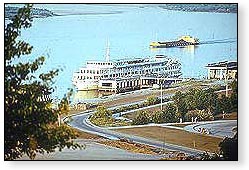 All of the greatest cities of European Russia have since
their foundation been intimately associated with the rivers that they adjoin.
Moscow, for example, sits at the confluence of the Moskva and the Neglina, and
St. Petersburg and Novgorod lay on the Volhov. The greatest of Russia's rivers,
however, is the Volga. At 2,300 miles (3,700 km), it is the longest river in
Europe, navigable for virtually its entire length. It was along the Volga that
the ancient trade routes of Russia were developed, giving rise to a whole
string of trading posts, fortresses, and towns during medieval times.
Yaroslavl, Uglich, Kostroma, and Nizhni Novgorod, four of Russia's most revered
and beautiful cities, are all situated along its banks.
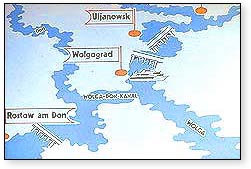
Yaroslavl
One of Russia's oldest cities, Yaroslavl was founded by
Yaroslav the Wise of Kievan Rus' in 1010. Over the next several centuries the
city prospered as a trading port on the Volga and a center of textile
manufacture, becoming by the 17th century the second largest city in Russia
behind Moscow. Its wealthy merchant community became notable patrons of the
arts, building hundreds of churches. Fortunately, the great majority of these
remain intact today, making the city one of the most beautiful destinations in
Russia.
Uglich
The approach to Uglich is one of the most memorable sights
of a cruise along the Volga. Bereft of the usual screen of Kremlin walls, its
especially fine churches and cathedral rise up from the horizon in a brilliant
play of red, blue, and gold.
The city's visual appeal, as well as its tragic past, have
made Uglich one of the most beloved cities in Russia. Founded in 1148, it
flourished during the 13th and 14th centuries, and was favored in the 16th by
Ivan the Terrible. Not only did Ivan use Uglich as a base for his campaigns
against the Golden Horde, but he also selected the city as the location of his
seventh wife's honorary exile from Moscow. Upon Ivan's death, his son Dmitry
joined his mother here, only to be brutally murdered by Boris Godunov as part
of his campaign to seize the crown. On the spot where the murder took place,
the city built the magnificent Church of St. Demetrius on the Blood, which
greets the eye of all who approach the city. The Cathedral of the Resurrection
and St. John's Church are nearby, similar in design and beauty.
Kostroma
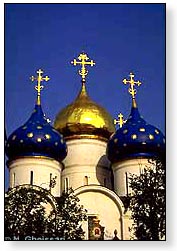 Kostroma's
associations with great figures in Russian history is second only to Moscow and
St. Petersburg. It was founded in 1152 by Yuri Dolgoruky, who also gave Moscow
its start. Kostroma experienced its first great period of prosperity as the
home of the Godunov family, which arrived in the 14th century and quickly rose
to prominence in the region. By the time that Boris Godunov enjoyed his brief
and tragic reign as tsar, the city had become the third largest commercial
center in Russia, surpassed only by Moscow and Yaroslavl.
After Godunov's fall and the Time of Troubles, the throne
was offered to Michael Romanov, whose family had long been fierce opponents of
the Kostroma Godunovs. However, as chance would have it, it was in Kostroma
itself that Michael was elected Tsar. The city of his enemy became a sort of
adoptive hometown, and the Romanovs continued to provide the city of he fallen
Godunov's with influential patronage. Although Michael began this tradition, it
was Catherine the great who eventually had the greatest impact on Kostroma's
appearance. After a disastrous fire in 1773 which destroyed all but a few
buildings, Catherine decided to turn the city into a showpiece for her enlightened
design principles. She sent in a slew of her best designers from St.
Petersburg, and within a few years Kostroma had been transformed. The
city center remains as one of the finest examples of late 18th century
architectural principles in Russia. Of particular interest are Susanin Square,
the Ipatyevsky Monastery, and the outdoor museum, containing a number of fine
examples of traditional wood-construction architecture.
Nizhni Novgorod
Nizhni Novgorod was until quite recently a closed city, best
known to westerners as the exilic home of Andrei Sakharov after he denounced
the war in Afghanistan. Nizhni is Russia's third largest city and a major
industrial center. Although it dates back to the 13th century, the majority of
its most interesting sights are from later periods. Foremost among these is the
city's great, brooding Kremlin, built during the 16th century.
Volgograd
Formerly and most famously known as Stalingrad, this
historic city was founded in the late 16th century to defend the land that Ivan
the Terrible had wrested from the Tatars. Then known as Tsaritsyn, the city was
for the first several centuries of its existence primarily a military
stronghold. In fact, the bulk of its history is one of military conflict. Late
in the 17th century, and again in the late 18th century it was captured by
Cossack rebels. During the civil war that followed the October Revolution, the
city was defended by Stalin and other Bolshevik commanders. In 1918, it fell to
the White Russian army, but was retaken two years later. In 1925, as Stalin
rose to power in the Soviet government, the city was renamed Stalingrad.
By World War II, Stalingrad had become a major commercial,
industrial, and transportation center. It was also the regional center for the
rich Caucasus oil fields. All of which, of course, made it quite attractive to
Nazi Germany. In the summer of 1942, just as the Soviet Union was turning back
the German offensive against Moscow, Hitler launched a major drive toward
Stalingrad. The German force numbered over half a million men, including units
from a number of different Axis countries. Stalin ordered that the city be held
at all costs, and Hitler ordered that it be taken at all costs. The Soviets,
vastly outnumbered and outgunned, resisted with a tenacity that is scarcely
credible. The Germans were forced to fight house-to-house, slowly working their
way through the city by reducing it to rubble. By November, the Germans had
still not been able to extricate or overwhelm the small remaining Soviet
garrison. General Freidrich von Paulus, their commander, thought it time to
withdraw--Hitler refused. Within weeks, two Soviet forces had encircled and
captured all of the remaining German forces. The city had been relieved, though
there wasn't really any city left.
 The
battle of Stalingrad has long been considered the critical turning point of
World War II. Had Hitler succeeded in his attack and taken control of the
Caucasus oil fields, he would have had enormously greater resources with which
to fuel his armies. Having failed to do so, and having lost an enormous and
experienced army in the process, was disastrous. After Stalingrad the Russians
advanced almost continuously all the way to Berlin.
The reconstruction of the city began immediately. Its heroic
defense is commemorated by the remarkable 170-foot statue of Mother Russia
wielding a great sword of victory. The statue stands atop Mamai Hill, the site
of the battle's most intense fighting. Although nothing survives of the old
city, Volgograd is once more a prosperous commercial and industrial center.
Comments
Post a Comment